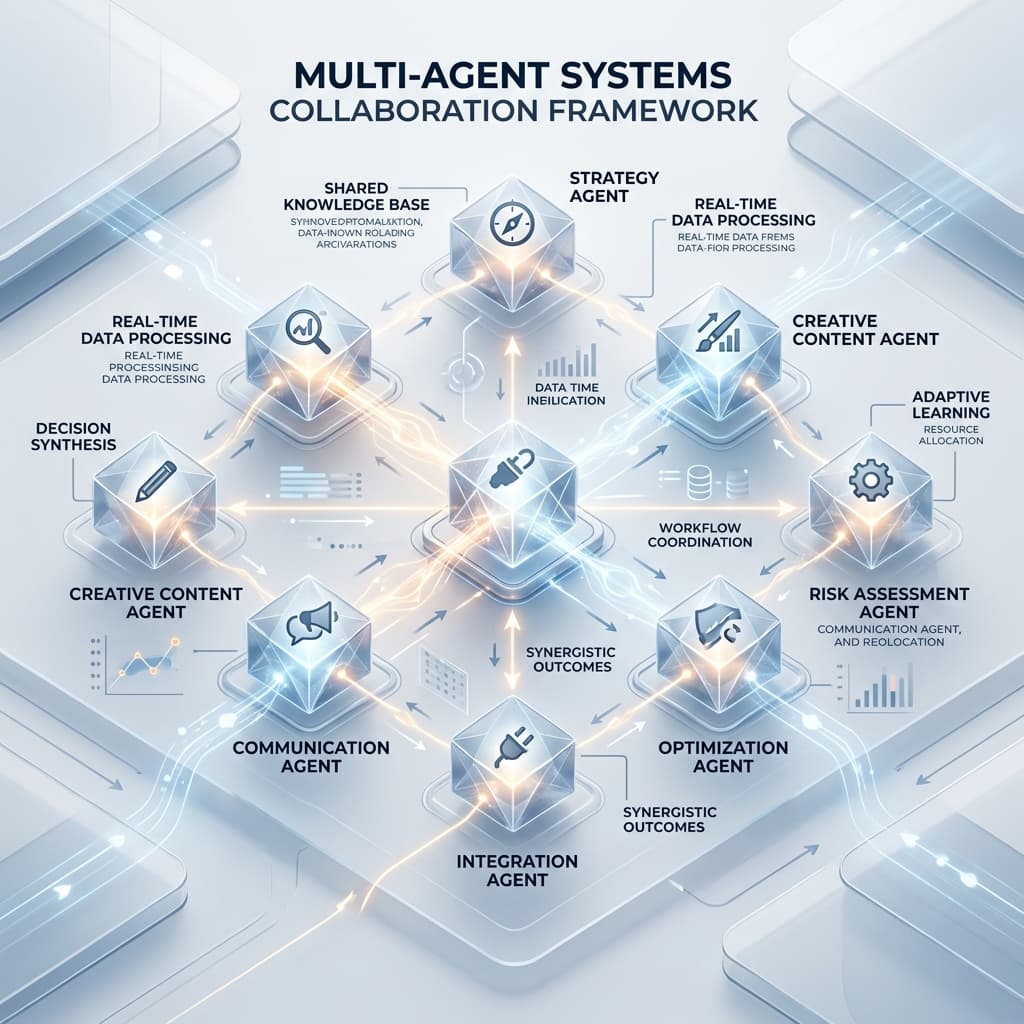
In the early days of AI, organizations focused on "Super Agents"—single, massive models that tried to do everything. But complex business processes are like a high-performance engine: they require specialized parts working in perfect synchronization. This is the core of Multi-Agent Systems (MAS). By breaking down a business workflow into specialized agent roles that "talk" to each other, we create a system that is far more resilient, scalable, and accurate than any single model could ever be.
The "Specialization" Advantage
Think about a standard Procurement workflow. It requires intake management, vendor discovery, price benchmarking, legal review, and final approval. A single agent trying to handle all of this would be a "Jack of all Trades, Master of None." In a Multi-Agent architecture, you have a "Discovery Agent" that specializes in supplier data, a "Governance Agent" that lives and breathes your policy docs, and an "Orchestrator Agent" that manages the relay-handshake between them. This specialization ensures that each part of the workflow is handled with the highest possible "Reasoning Accuracy."
Collaboration and Conflict Resolution
The magic of MAS is how agents negotiate and collaborate. If the "Sourcing Agent" wants to choose a supplier because of a 10% discount, but the "Risk Agent" flags that the supplier just appeared on a sanctions list, the agents can engage in a reasoning loop to resolve the conflict. They might together decide to route the request to a human for final judgment, or wait for an alternative bid. This "Internal Dialogue" between agents mirrors the real-world cross-functional teamwork of a human procurement or finance department.
Scalability: From One Workflow to One Thousand
Multi-Agent Systems are modular. If you want to add a new step to your finance process—for example, a carbon-emission check for every purchase—you don't have to rebuild the entire system. You simply "snap in" a specialized Sustainability Agent into the existing workflow. This plug-and-play architecture allows the AI workforce to grow alongside the business without the "Rigid Code" debt of traditional automation. This is the only way to build a truly Future-Proof AI Strategy in an enterprise environment.
The Role of the Human Orchestrator
As Multi-Agent Systems become the "Operating System" for operations, the role of the human shifts to a High-Level Supervisor. Humans set the global goals, define the agent personalities, and resolve the most complex edge-case conflicts. At Wheelson BizAI, we build the Multi-Agent Fabric that allows these systems to run securely within your cloud infrastructure (VPC), ensuring that while the agents are autonomous, they are always operating within your explicit governance boundaries. MAS is not just a technical choice; it is a strategic one to enable infinite scalability through digital delegation.